Category Archives: Savory

Stuffed Bread

You all know the story of the pasty, right? If you don’t, you should.

As I am given to understand it, this little jewel of meat and vegetable, wrapped in golden flaky crust, was developed by the families of Cornish miners as the original hot lunch-in-a-box. The wives of the miners (wives, of course, because this is the patriarchal past — as opposed to the patriarchal present) would pop a couple of them in the oven before dawn, then hand them to their husbands — wrapped in newspaper — on their way out the door. And the pasties would stay warm, all the way until lunch.

They’re still popular in England as a kind of fast-food option, filled with everything from meat and potatoes to curry. Or at least they were when last I was there. And they’re popular, too, in the United States, wherever Cornish miners and their families immigrated. So: Michigan, Wisconsin, Northerneastern Pennsylvania, and so on.

Today’s experiment — alas — is not a pasty. Nor is it one of the pasty’s dozens of equally interesting, possibly more famous cousins: the tamale, empanada, calzone, or the like. But it shares some history with its short-crusted cousin. And it certainly shares some inspiration. The point of stuffed bread — today’s recipe — is that it makes great, portable convenience food. Eaten directly out of the oven, it makes a satisfying breakfast, lunch, or dinner. Or pulled out of the oven and wrapped up, it’s great on road trips (where a knife and fork aren’t always a good option), or at work, or any time at all.

As you read through this recipe, you might consider that it is more a beginning than an end. The stuffed bread, as you see it here, will come out very well indeed. But to my mind, it is a sort of template from which to work. Depending on the season, and depending on your eating habits, you may wish to change the filling. Or you may wish to change the type of bread into which it gets stuffed. It is sort of a genre, stuffed bread is, and not one specific dish. So look, tinker, modify, and adapt. I know that I will, and that there is every likelihood that you’ll see other stuffed breads in this space — including, maybe, actual pasties — as time goes on.

For the bread:
550 grams AP White Flour
350 grams Water
1.5 tsp Salt
1/2 tsp Rapid Rise Yeast
1 Egg + 1 tsp of Water (for an egg wash)

For the Filling:
3 Sausage Links, cut into slices (I like Andouille)
2 Onions, sliced thinly
4 Cloves of Garlic, minced
1-2 tbsp Balsamic Vinegar
1/2 tsp Dried Thyme
1/2 tsp Dried Rosemary
1/2 tsp Dried Tarragon
1/4 tsp Cayenne Pepper
Olive Oil
Black Pepper
Salt

The night before: add 150 grams of the flour, 300 grams of the water, and the yeast to the work-bowl of your stand mixer (or to any medium-sized mixing bowl, if you don’t have a stand mixer). Stir together well, cover, and allow to sit on the counter overnight.

The day of: to that same bowl, add the rest of the flour and water, and the salt. Mix until all of the ingredients come together into a shaggy dough, then knead for about 10 minutes on medium-low in the stand mixer (or 15-20 minutes by hand), until the dough changes texture, becoming silky-smooth and elastic. Form the finished dough into a ball, place in a second bowl that has been lightly lubricated with vegetable oil, cover, and allow to rise for 2.5 to 3.5 hours, until it has just about tripled in size (the exact length of time will depend on the temperature of your kitchen).

About an hour before your dough has finished rising, heat a pan over a medium flame with some olive oil. Add the onions, herbs, cayenne and black pepper, and a little bit of salt, and cook, stirring occasionally, until the onions have thoroughly softened and have just started to brown. Then add the vinegar, garlic, sausage slices, and a little bit more salt and allow to cook together until the sausage is done and most of the liquid has evaporated from the pan. Remove from the heat and allow to cool to just warmer than room temperature.

While you’re waiting for the filling to cool, line a cookie sheet with parchment. Gently punch down your dough, and divide it into six equal pieces (they should be about 150 grams apiece). One ball at a time, on a floured surface, use a rolling pin to flatten your dough into a slightly oblong circle (sort of a wide oval, really).

To fill it, add 2 to 3 tablespoons of cooled filling to the center of the oval. Then wrap it up sort of like a burrito: bring the short sides of the dough together over the top of the filling; then stretch one of the larger flaps over the top of that; then roll it all up in the remaining flap, stretching it just a bit to cover as much of the filled dough ball as you can. As you finish each filled ball, remove it to the lined cookie sheet. And don’t worry about pinching them closed too much. If you make sure that their seams are facing down, they will hold themselves together.

When you have made all the filled balls, preheat your oven to 400F, cover the cookie sheet loosely with plastic wrap (or a moist towel), and allow the bread to proof for 55 minutes. At the end of that time, brush each ball lightly with the egg-wash, then place the cookie sheet into the oven, and allow the breads to bake for 25-30 minutes, until they are golden brown on top.

You can expect some minor spillage as the stuffed bread bakes. But no worries. That is part of their charm. They can be served directly out of the oven. Or they can be saved and reheated later, and they will be just as good.

Enjoy!

(You can, of course, find many more fabulous bread recipes through Wild Yeast’s YeastSpotting Archive!)

Vegan Kale Pesto

Earlier on in my life — from the time I was about fourteen almost until I graduated from college — I was a vegetarian. I know. It seems difficult to believe, given the thrust of this blog, given my posts about pig parts and chicken feet and so forth, given the number of veg-heavy recipes to which I add Thai fish sauce — just for kicks. But it’s true. I ate some seafood for the first couple of years — I don’t think that my mother would have known what to cook, otherwise. But by the time I got to college, I was pretty strict. Eggs and dairy, yes. Other animal products, of whatever kind, absolutely no.

Why did I give it up, you ask? Well, Sarah and I gave it up together. We had been kicking the idea around for a little while. She was having some energy-level problems. I desperately missed shellfish. We ate a couple of meals in restaurants over the course of several months in which we there was just a tiny bit of meat, here and there. And then there was Thanksgiving, 2002.

Thanksgiving day, we had a giant fight — like disturb-the-neighbors kind of giant — about something that was probably stupid, and definitely not food. We were together in Berkeley for the holiday: neither of us was going home, or seeing family, or anything like that. After spending most of the day mad, there must have been some sort of tentative apology. I don’t remember the details. But what I do remember — pretty vividly — is that almost without a word between us, in the middle of the afternoon, we drove out to the Safeway on Shattuck Avenue and bought whatever turkey was left that wasn’t frozen.

I cooked it. We ate it. It was delicious. And that was that. Our vegetarian days ended just in time to enjoy a scattering of the not-so-veg-friendly delights that the Bay Area has to offer before we packed up our U-Haul, hitched it to my poor (now deceased) Toyota Corolla, and moved to Southern Indiana.

But just because I left my — um — salad days in the rear-view mirror, there in Berkeley, it does not mean that I left my enthusiasm for meat-free eating, or my sympathy for those who choose not to partake, behind. I was not a vegetarian for political reasons, or for the sake of animal rights. And yet, I recognize that given the horrific conditions of industrial meat production, and given the environmental disaster that is the result, eating less meat is better, and depending on the circumstances, eating no meat at all might be best.

That is not my solution. I stand, on this issue, with Michael Pollan. I try my best, where it is possible, to eat only meat the provenance of which I know. At home, our meat comes largely from small producers, or barring that, from humane operations (I often have to take Whole Foods’ word for it on this account). The theory behind this is twofold: 1) ultimately, I really like meat; and 2) while there may never be enough vegetarians in the United States to change agribusiness on a large scale, by voting with our pocketbooks for certain kinds of products over others, we may yet, collectively, be able to do some good.

Whether that works or not, I do not know. The no-meat perspective has a lot of merit in my mind as well. What I do know is that in our household right now, while there is a lot of meat, our overall food consumption tilts probably eighty percent toward the vegetable. What I do know is that from my perspective, the best diet is the one with the maximal amount of variation. And what I do know is that, despite my sometime porkatarianism, I am always on the lookout for good veg and vegan recipes that I can rotate into my cooking routine.

Which is why I was so pleased, to put it mildly, when friend of the blog and sometime contributor Sharyn mentioned vegan kale pesto on her Facebook. She raved about its virtues. The other posters on her status raved about its virtues. As a lover of bitter greens, I chimed in and asked her if I could steal the idea. And she said: by all means.

So I did a little bit of poking around and a little bit of experimentation. My goal, initially, had been to post a vegan and non-vegan version of the dish. But by the time the food processor stopped whirling and I got my first taste, I had changed my mind. Let me tell you, dear readers: vegan kale pesto, with nutritional yeast (so much better than it sounds!) doing the umami work of Parmesan cheese, is so delicious that there is no need for a non-vegan alternative. Go out and get the one ingredient in this that you probably don’t already have at home. It’s cheap. And good. And you definitely won’t regret it.

(Nutritional Yeast)

Anyway, here’s how to make it: Vegan Kale Pesto.

1/2 lb. Dinosaur Kale, stemmed
8 Cloves of Garlic
1 cup Walnuts
1/4 cup Extra Virgin Olive Oil
Juice of 1/2 Lemon
1 tbsp Nutritional Yeast
Black Pepper
Salt

Blanche and Shock the Dinosaur Kale (drop it into boiling water for 40 seconds, then immediately remove it to ice-cold water to stop the cooking).

Add the garlic and walnuts to the work bowl of a food processor, and pulse once or twice, just to chop it all up a bit. Add the rest of your ingredients, including the kale, and run the food processor until all the ingredients are chopped finely, and the mixture forms a coarse paste. If the pesto seems a bit dry, add another tablespoon of olive oil and a tablespoon of water, and pulse once or twice more to mix.

Kale pesto should keep in your refrigerator for a couple of days. But I doubt that it will last that long, once you taste it. I would recommend serving it over pasta, with sautéed extra-firm tofu and mushrooms.

Pasta with Collards and Bacon

When is he going to make another post about collards?

I know, I know — that’s the question that’s been on all of your minds. You can’t resist those broad leathery leaves, dark green in both look and smell. You can’t resist that bitter taste, or that extensive history, or that big shiny 1000 on the ANDI scale.

The answer, of course, is right now. I’m going to make another post about collards right now. And it’s going to be a quick-and-dirty one. Because I’m headed out of town on an academic errand, and I have so very much to do before I leave.

So here it is — pasta with collards and bacon. This is a recipe, dear readers, that takes one of the finest foods ever imagined and … and adds some greens to it.

1 lb Extruded Pasta (I used shells this time, but I’m fond of this with ziti or gemelli, too)
1/2 lb Bacon, diced
2 Bunches of Collards, stemmed and chopped
2 Medium Onions, sliced
1 quart Mushrooms, sliced
5 Cloves of Garlic, minced
1 tsp Oregano
1 tsp Crushed Red Pepper
1/2 tsp Thyme
1/2 tsp Fennel Seeds
Parmesan Cheese
Pepper
Salt

Fill an 8-quart pot with water, add ample salt, and set it on the stove to boil. Meanwhile, to a sauté pan over medium heat, add the diced bacon and allow to cook, stirring occasionally, until almost crispy. Then remove the bacon with a slotted spoon. To the leftover grease, add the sliced mushrooms, along with a little bit of salt, the thyme, the fennel seeds, and the red pepper flakes, and cook for about 5 minutes, just until the mushrooms start to brown. Then add the onions, along with a little bit more salt, and cook for about 20 minutes, until the onions have mostly softened.

At this point, your pasta water should be boiling. To the sauté pan, add the minced garlic, the dried oregano, pepper to taste (I like about thirty turns of the grinder), and the cooked bacon. Cook for about five minutes, stirring constantly to make sure that the garlic does not burn. Then, add the chopped collard greens to the pan, closing the lid. And add your pasta to the boiling water.

As the greens begin to wilt, you’re going to want to stir occasionally to mix them in with the rest of the ingredients. I have found that a good pair of tongs is best for doing this.

At the end of about ten minutes, when the pasta is al dente and the greens are cooked, drain the pasta (not too well. A little bit of pasta water does wonders for this dish!) and add it to the saute pan. Add the Parmesan cheese and a bit more salt and pepper (to taste), and mix thoroughly. Allow the entire dish to cook together for five more minutes, to allow the flavors to blend. And then serve while hot.

Enjoy!

Beef Stew with Figs

I’m sick. Again. For the second time this month. I don’t want to make too much of it, because two colds in a month is hardly a sign that the world is coming to an end. But it means bad sleep, and daytime raggedness, and not wanting to do a whole lot of anything. And I rarely get sick, so when I do — perhaps I’m a little prone to whining.

Please, though — don’t tell Sarah I said that. Her smugness at my admission will be almost as unbearable as this damnable sore throat.

Anyway, just because I am sick, it does not mean that I have been idle. In fact, my impending second illness has snapped me back into cooking mode. I had already planned to make a beef stew sometime this week, but as I felt my sinuses grow raw and my uvula hang just a bit uncomfortably low, I thought to myself: I need something hardy. I need something that will fill me up, fortify me, feel nutritious. And I need something that — after a bit of initial chopping and browning — I don’t have to think about for two or three hours as it bubbles away in the oven.

But while beef stew is always good, it’s sometimes a little bit on the workaday side. It is meat and potatoes, after all. And brown gravy. I like it. A lot. As I like pretty much anything that is braised or stewed. But as I am wont to do, I look at it and think: what else can I do with it, that will preserve the dish’s traditionality, but that might add just a little — I don’t know — oomph?

The answer? Dried fruit!

(This looks like a really long list of ingredients. But it’s not complicated. More or less, you just throw them together and let them cook.)

2 lb Beef Stew Meat, cubed
1 cup Dried Figs, chopped
1 cup Dried Apricots, chopped
.75 lb Yukon Gold Potatoes, cubed
1 pint Mushrooms, stemmed and quartered
1 Onion, sliced thinly
2 Carrots, cubed
4 Cloves of Garlic, Chopped

2 cups Stock (I used chicken, but it would probably be better to use beef)
1 cup Red Wine
6 tbsp Beurre Manié (equal parts flour and unsalted butter, mashed together really well)

3 Bay Leaves
2 Star Anise Pods
1 Whole Clove
2 tsp Ras el Hanout (you may need to find a specialty store for this, but it’s worth it)
1 tsp Cumin Seeds
1 tsp Dried Thyme
1/2 tsp Ground Cayenne Pepper
Cubebs (about 25 turns on a pepper grinder)
Black Pepper (about 25 more turns)
Olive Oil
Salt

Preheat your oven to 275F. Add a little bit of olive oil to a heated dutch oven over a medium flame on your stovetop, and brown the beef cubes on all sides, adding a little bit of salt as they cook. Remove to a plate. Add the onions and carrots, along with a little more olive oil and salt, and cook until the onions just start to brown. Then add the cumin, cayenne, cubeb, black pepper, and garlic, and cook for about five more minutes, stirring to make sure that the garlic doesn’t burn.

Return the browned beef to your dutch oven, then add the rest of the herbs and spices, the dried fruit, the stock and the wine. Stir well, and be sure to scrape the bottom of the pan to dislodge any tasty burned bits. When the mixture comes to a boil, cover your dutch oven with a lid and place it in the oven for one hour.

At the end of the hour, remove from the oven, mix in the mushrooms and potatoes, then put it back in the oven — this time uncovered — and cook for another hour and a half.

Finally, at the end of that time, move the dutch oven to a stove-top burner on medium. Add the beurre manié, and stir thoroughly until it dissolves. Then let it bubble for about 10 minutes, to allow the gravy to thicken and the flour to thoroughly cook.

Serve over brown rice.

Chicken Stock (From Chicken Feet)

Standing by the counter at Godshall’s Poultry, waiting for my number to be called, I found myself chatting with the woman ahead of me in line. Like me, she had come for stock-making provisions — pieces and parts, cheap bits, to populate her pot. She pointed the poultry man in the direction of the necks and backs, then toward the stripped breast bones. And while he was working on her order, I asked her: Have you tried chicken feet in your stock?

She cringed, and made a little noise of revulsion. Really? Chicken feet? But they’re so — gross.

I told her that they are. A little bit. But that never have I made better stock than when I include a pound or two — or three — in with the rest of my chicken trimmings.

I am a believer that stock should be mostly a matter of leftovers — that one should freeze the carcasses of roasted chickens, then toss them in a pot with mirepoix, herbs, and a tiny bit of salt, and let the whole thing go at a simmer until it’s time for bed. But experience has led me to the conclusion that stock can’t just be from leftovers. The bones of roasted birds past have lots of flavor, but they never have quite enough gelatin left in them to impart the richness — the mouth-feel — that makes using stock in a recipe a step up from water, or wine, or something else. And nothing imparts more gelatin, more richness, than feet.

I chatted with the woman for a while longer, describing to her the Jello-like consistency of my cooled stock, telling her about the wondrous risottos it had made and the squash soup that was just a little ways down the line (this was right before Thanksgiving). And eventually, I guess I wore her down.

Also, she told the poultry man, I’ll have a pound of chicken feet. To try.

She paid for her chicken bits, and turned to go. But before she left, she told me in a most serious tone: Now I’m going to give this a try. And I hope it’s good. Because if it’s bad — I’m holding you responsible.

In all seriousness, though: Chicken feet do look — gross. But they are the world’s best addition to stock. They add body to your liquid without adding too much flavor, which is good, because you want stock to be rich without overwhelming the flavors of whatever you’re cooking. Buying them prevents massive amounts of perfectly serviceable chicken parts from getting thrown away, or processed into McNuggets, or whatever it is they do to the bits that don’t get eaten. And in using them, you are connecting with a culinary tradition that goes back hundreds of years. You are cooking like somebody’s grandmother. And there is nothing inherently cooler than that.

Anyway, here is now you make the stock*

2-3 lbs. Leftover Chicken Carcasses
2-3 lbs. Chicken Feet (you should have about 5 lbs of chicken parts in total, any way you divvy it up)
2 Onions, roughly chopped
2 Carrots, roughly chopped
3 Ribs of Celery, roughly chopped
3 Bay leaves
Fresh Parsley
Dried Thyme
10-20 Whole Black Peppercorns
Salt (just a little; you want to be able to control the seasoning later)

To an eight-quart stock pot, add your chicken parts, onions, carrots, celery, herbs, and salt. Then fill the pot with cold water until it covers all the solids (preferably by an inch or two, though I recognize that that’s not always possible). Heat on the stove on high until the contents of the pot reach about 190F, then turn the stove down to low, and allow to simmer, covered or uncovered, for about six hours.

You may want to stir occasionally, though that isn’t a requirement.

At the end of the six hours, pour your stock through a fine mesh strainer, pressing down on the solids with the back of a ladle to squeeze out any clinging juices. Strain a second time (I do this, but you don’t absolutely have to). Then cool the stock in a water bath and get it into the refrigerator ASAP (important, because bacteria starts growing in chicken stock super quickly).

The next morning, remove the stock from the fridge. The fat should have solidified on the top, and the stock itself should have a gelatinous consistency. Skim off all the fat, then return the stock to the stove, bring it back to a boil, and allow it to reduce until just four cups remain.

Cool the reduced stock (again, in a water bath if you can), then pour into two ice cube trays and freeze. The stock can later be reconstituted for use at a ratio of one cup of water to one cube of stock.

Strictly speaking, reducing and cubing the stock is not absolutely necessary. But it makes having home made stock in the house so convenient that you’ll never want to eat that over-salted store-bought slop again.

Trust me.

* For the record, I am aware that somewhere in the legacy posts I ported over from Livejournal, there is a similar recipe floating around.

Jamón Ibérico

I have, as you may have guessed about me already, a great deal of sympathy for ham obsession. I have myself, on a number of occasions, made the circuit in Philadelphia from the Reading Terminal Market, to the Di Bruno Brothers, to Claudio’s, looking for just the right crudo to pair with scallops, or melon, or whatever the experiment of the week might be. I have sampled five or six types, then settled on two or three, figuring that the ham I didn’t use would undoubtedly find a good home in some other project. Like my lunch. I wouldn’t say that I am an expert. Hardly. Rather, I would call myself an enthusiast for the cured leg of the pig. Because I am, if nothing else, very enthusiastic.

But enthusiasm can be a relative thing. And I think that I didn’t quite understand ham enthusiasm — ham obsession — until I spent some time in Spain.

Ham obsession is a serving of jamón, along side bacon, as part of a nutritious breakfast. It is a slice of jamón laid across a dry split baguette for lunch — because who needs a condiment? It is a ración of jamón at the top of every menu of every restaurant, tapas bar, and cervecería, often offered in several different sizes and levels of quality, for every occasion and every price point. It is a cab driver in Barcelona exclaiming in horror: “You mean that jamónes in the United States don’t have a hoof? But how can you tell whether they’re the [low-end] white kind, or the [premium] black kind? The black ones are so good!”

That kind of outburst — not from a chef or even a foodie — is what I mean by ham obsession. There is a kind of passion for jamón in Spain — a pain-pleasure thing that straddles the border between religion and sensuality — that I as an outsider can’t wholly understand. It is in part a Catholic thing. Famously, after the expulsion of the Muslims and then the Jews in the Middle Ages, pork consumption became a signifier of religious conformity — a sign, to the Inquisition among others, that I, good Spaniard, am not in need of your cruel ministrations.

But it’s more generalized than that, too. There is a kind of ritual about the consumption of jamón: ordering a ración, laid out on a platter in radiating circles; picking out just enough, held between the finger nails, to lay across a wafer of crusty bread; eating it with slow relish, accompanied by a glass of vino tinto, or sometimes café con leche. And there is a kind of delaying of gratification: the sweet suffering of customers at the deli counter or the bar, watching appreciatively as a skilled knifesman painstakingly hand-cuts slice after razor-thin slice, filling that platter at his own pace. No faster.

We could never love ham like that in the United States. We don’t have the devotion. We don’t know how to wait.

And frankly, we don’t really have the jamón. The fanciest pig parts that show up at Di Bruno’s or Claudio’s are good, more ore less. They have some of the creamy texture, some of the subtle flavor. They have some marbling of fat. But the best — at least Spain’s best — rarely leaves the country. Until 2005, the real jamón Ibérico, made from black Iberian pigs who foraged on acorns, was unavailable in the United States. Today, some comes in, but it is prohibitively expensive, and not the highest quality.

While I was in Madrid, I walked into a quality charcuteria — Julián Becerro, where a large number of the photos in this post were taken — and they made this point abundantly clear. I told them that I love jamón at home, and that I wanted to try something that I can’t get in the United States. And the clerks laughed at me. Pick anything in the store, they told me. There is nothing here that you can get in the United States.

And then a clerk walked me over to a wheel of jamónes, legs radiating out, their hoofs in stirrups, where knifesmen were cutting away. He explained to me in very limited English that each leg on the table was a different variety — fed differently, with a different provenance, flavor, and price point. He cut for me some samples, and I understood.

I ended up buying just a few slices of one variety of jamón bellota — an acorn-fed ham that was unlike anything I had tasted before, and certainly unlike anything I have ever gotten at home. In texture, it is silky, oily, fatty — like the best thin-sliced lox, almost like soft wax in a warm room. In flavor, it’s mild and creamy like other hams, but with an intense nuttiness, both sweet and slightly tannic, layered on top of that. It tasted like acorn, I would suggest, in the same way that really fresh milk tastes like pasture grass.

With our slices in hand, Sarah and I made our way from Julián Becerro, a couple of blocks to Madrid’s Plaza Mayor, where we sat ourselves down, tore open the wrapping, and ate the entire package with our fingers. Was it jamón obsession? I think not. Sarah has expressed that, with only a couple of exceptions, she *was not impressed* by a product that is as often very bad — served in stale, pre-packaged sandwiches in museum cafeterias — as it is very good. And even I, by the end of our journey, was wishing that some of the jamón, a little bit of the jamón, could be replaced by a fresh salad or some nice green kale.

But I would suggest that it is sympathy with ham obsession. After two weeks in Spain, eating jamón every day whether I wanted it or not, I don’t have the feeling that I’d like to go without it for a good long while. I don’t need a separation from ham, or time to remember that when it’s absent, I miss it. I like jamón. I am enthusiastic. And while I learned something about it’s relative quality from my time in Spain, I don’t plan to let that spoil my enthusiasm for ham at home.

“Two Great Tastes that Taste Great Together”: Sweet Potato Grits

Elizabeth is a folklorist, a teacher, and a culinary experimenter with a low boredom threshold.  She and her partner have recently added a giant puppy to their household; he impedes the experimentation, but she loves him anyway.  They live in a large, old house with a small, old kitchen in upstate New York.  Elizabeth blogs at www.breadandhoneyblog.com.

Somehow, I never got around to grits until this winter.  My mother grew up in the South and she loves them; but my father is from the North and he doesn’t.  So the grits of my childhood were infrequent spoonfuls from Shoney’s breakfast buffets; white and wet and bland and, well, gritty.  Forgettable, if not for the dissonance between my Mama’s evident pleasure and the watery puddle creeping towards my French toast fingers.

As an adult, I became a lover of all porridgy foods: steel-cut oatmeal, risotto, polenta, congee.  But not grits — not until, just a little while ago, I was served cheese grits as a side dish at the White Dog Cafe in Philadelphia.  Heavens!  I don’t remember what unremarked entree they sat beside.  But I vividly recall their puddingy, cheddary goodness.  If ever a food was as comforting as a warm nap (or necessitated a warm nap), this was it.

My first couple of attempts did not, alas, achieve that level of homespun glory.  For one thing, I didn’t know anything about how grits should look in the pan, or how a grits-friendly recipe should be shaped.  Once they came out clumpy.  Once, sticky with cheese.  Once: “You put eggs in this?” a southern friend asked in polite astonishment, tasting a cheese-laced, grits-based casserole.  “You don’t need eggs in cheese grits.”  This perfectly paralleled my rice pudding experience, which culminated in the production of an eggy, gelid, baked rice pudding I found so repulsive that I tipped the whole quivering mess into the bin.

I thought I should simplify my approach to grits.  Start with the basics.  But basic grits, in my experience, were boring.  I set them aside for a while, as a puzzle I hadn’t solved.  I put grits in the mental storage locker where I keep the rice pudding and also pumpkin pasta sauce and pad Thai, all culinary challenges I have yet to overcome.  But grits weren’t quite done with me.

Three times in the last month, I stumbled across the very same recipe for Sweet Potato Grits.  It comes from Virginia Willis’ new cookbook, Basic to Brilliant, Y’all, a Southern-flavored, French-influenced collection of dual recipes: one basic, one tarted up for company.  I suspect that the Sweet Potato Grits recipe — and its fancier-pants companion, a grits-based spoonbread — have been distributed for publicity purposes; they certainly offer an enticing glimpse of the potential inherent in Willis’ approach.

As it happened, I was just about to host a brunch whose guests were all Southerners or celiacs (or both), so grits were an obvious choice.  When I mentioned the recipe to a friend and he said, “Two of my favorite foods!  Together at last!” it seemed fated.  I approached the recipe with some trepidation, given my grits experience (or lack thereof).  But did I make it once the week before to try it out?  Of course not.  I got out my heavy-bottomed saucepan on Sunday morning with a trembling hand.  The recipe calls for a cup of stone-ground grits, but I had plain Quaker old-fashioned grits languishing in the back of the pantry, so I used them.  Preparation was absurdly easy: heat the milk, add the cup of grits, whisking, and then the grated sweet potatoes.  Season and simmer for, oh, about an hour.

Actually it took a little over an hour; I consulted with a guest, who poked the orange mess in my saucepan with a wooden spoon and pronounced them done.  “But you can’t overcook grits,” she said, “So don’t worry.”

We finished with a dollop of butter as the recipe indicated, and then I added a swirl of cream because I am convinced that cream improves almost any dish.

The grits turned out saffron-colored, cinnamon-scented, and remarkably fluffy.  The slight sweetness of the potatoes and the hint of pie-type spiciness were just enough to stand in for the indulgent element at a brunch that lacked coffee cakes or cinnamon rolls or other deliciously indigestible gluten-filled brunchable baked goods.

Clean plates are the best compliment.

I don’t brunch often; indeed, I don’t even cook breakfast most mornings, because I’m so far from being a morning person that I’ve been known to set my bathrobe on fire while boiling water.  But now that brunch season is upon us, ushered in by the holidays, I’m pleased to add a new recipe to my repertoire.  These grits meet my need for ease in any morning cookery, and fulfill my dreams of creamy, fluffy, flavorful comfort food.

Perhaps it’s time to tackle rice pudding again.

Virginia Willis’ Sweet Potato Grits

  • 2 cups of water
  • 2 cups of milk
  • 1 cup of stone-ground grits (I used Quaker Old-Fashioned)
  • 2 medium sweet potatoes, peeled and grated
  • salt and pepper
  • 1/4 teaspoon ginger
  • pinch of cinnamon
  • 1 tablespoon butter

Combine the water and milk and bring to a low boil.  Slowly whisk in the grits.  Add the sweet potato and stir.  Season with salt and pepper (and I added the ginger and cinnamon at this point, too).  Lower the heat and simmer, stirring often, until creamy and thick.  (The recipe says 45-60 minutes; your results will depend on how slow your simmer is.)

When the mixture has thickened and the grits and the sweet potato are both tender, add ginger, cinnamon, and butter.  (I added heavy cream, too.)  Taste and adjust for seasoning.  Serve promptly.

Serves 4-6, generously

PS: I ate the leftovers for breakfast this morning, reheated with a bit more cream.  Lovely.

Lonely No More: Veg*n Holiday Cooking & Eating

Sharyn is a professor of English, avid runner, and champion napper. When not teaching, running, or under her beloved Slanket, she bakes vegan treats and greedily reads her friends’ blogs. Originally from Massachusetts, Sharyn has lived in southern Indiana for the past 8 years and earned her PhD in December 2011. (She’s wicked proud of it.)

Being vegan or vegetarian (veg*n) during the holidays can present a set of dietary challenges that may be compounded by the already-stressful nature of packing families, food, and quality time into a few short days at the end of the year. Food takes on a powerful connotation during the holiday season—the act of hosting and feeding others becomes an embodiment of Peace on Earth and Goodwill Toward Men. With all of that hanging over the meal, one’s food choices can take on a larger than life significance, as each thing one chooses to not eat disrupts the holiday spirit and leaves you open to accusations of Grinch-like behavior. Despite these potential problems, I’ve found that holidays as a veg*n can still be filled with warmth and fun and lots of sharing; in fact, there may be much more sharing than you ever expected.

Having been vegan for nearly 15 years now, I have had my share of holiday hassles. I’ve heard every joke, every silly question, every criticism of my dietary choices that exists. And often, I hear these comments from people who routinely stop at the McDonald’s drive-through for questionable “food.” By now, fortunately, my family is quite accepting of my lifestyle and choices, and holidays are much less stressful in the food department. Here are some things that have helped make that transition possible:

Learn how to cook or bake, or at least bring someone home with you who can. My husband, Brian, is an excellent cook. So excellent, in fact, that he does all the cooking for the two of us, and it’s all vegan, all the time. I’m the baker, and can put up pretty mean cupcakes and cookies come the holidays. The point is, being able to bring food to the table is a key component of the holiday season—don’t be left out! And it’s better for everyone if you can bring something truly homemade, rather than, say, frozen veggie burgers or something. Trust me, no one will hassle you if you bring them perfectly roasted vegetables or warm mashed potatoes or pecan pie truffles. Those truffles, in particular, are a Sure Thing—be ready to see them disappear, most likely without you even getting one. Which brings me to the next point:

Prepare to Share. Whether it’s out of hunger, politeness, or sheer curiosity, friends and family will want to try your treats. Back in the early days of my veganism, I would often have to say something like, “if you want to taste my dish, fine, but I don’t want to hear any criticism!” That, of course, is not the most friendly or heart-warming introduction to veg*n cooking, so I’ve learned to amend my approach. By bringing enough to share, not only are you participating in the spirit of the holidays, but you are letting others get a taste of veg*n life. Just make sure you get a taste, too!

And getting a taste means not only indulging in your favorite treats, but getting a taste of the holiday cheer, too. So much stress about the holidays comes from having unrealistically high expectations, lots of family and friends in close proximity, and neglecting yourself. Make sure to enjoy your favorite holiday foods and allow others the same courtesy. In other words, beyond introducing folks to the deliciousness of your recipes, save the veg*n evangelizing for another time. No doubt there will be family members teasing, taunting, or questioning, but for the sake of holiday harmony do your best not to take the bait and not to lose your patience. By no means should you shrink from an honest discussion of diet health and ethics, but there’s probably no need to rattle off factory farming statistics to your drunk Uncle Jerry while in the church foyer awaiting the kids’ holiday pageant, for instance. (In fact, that situation might mean problems much bigger than your veg*n diet.) Throughout the years, I’ve found that the sharing and indulgences now go both ways at my family celebrations. My family accommodates my diet now, even getting excited when they find vegan snacks and pastries that I can eat. They also make special requests—this year, I am to make this delectable maple pecan pie for Christmas dessert. (side note: I recommend making and pre-baking Mark Bittman’s pie crust instead of the one in this pie recipe, using 2 TB of Earth Balance shortening and 6 TB of Earth Balance buttery sticks in place of butter. It comes out so perfectly flaky and delicious that no one will realize! Or at least they won’t care!) So, have courage dear veg*ns; the holidays are meant for all to enjoy as they wish, and you are no different. It just means being proactive about your own enjoyment and being prepared with delicious goodies to share.

Remember to be kindly about sharing, as well. Every year I think I might get Brian’s expertly roasted Tofurky all to ourselves; yet sadly, his technique truly makes something special out of what is otherwise an underwhelming meat alternative, and I am always left without seconds. But it’s worth it to see so many happy faces around the dinner table, and to see all of us sharing a meal in the true spirit of the holidays.

Here are Brian’s tips to get the most out of a store-bought Tofurky Roast, should you choose one for your holiday meal:

  • For the glaze, don’t go by the box instructions. Simply use equal parts olive oil, tamari, and orange juice, with a pinch of fresh sage, and brush the roast with it.
  • Surround the roast with lots of fresh veggies—potatoes, carrots, celery, and onions are perfect—in the baking dish.
  • Make sure you keep the roast surrounded with about 1/4 inch of liquid (veggie stock, preferably, but water will do) while it’s in the oven; this way, when you cover the dish with foil, steam will be created, keeping the roast moist as it bakes.
  • When you remove the foil to finish baking the roast, spritz it with olive oil spray before putting back in the oven, uncovered. This helps create a nice, dark, tasty skin.
  • When the roast has finished baking, let it sit for at least 5 minutes before attempting to slice it. This insures the moisture and temperature have a chance to even out.
  • Ignore the stuffing inside the roast—it’s honestly not very good, but a well-baked Tofurky can still be a delicious centerpiece to a holiday meal.

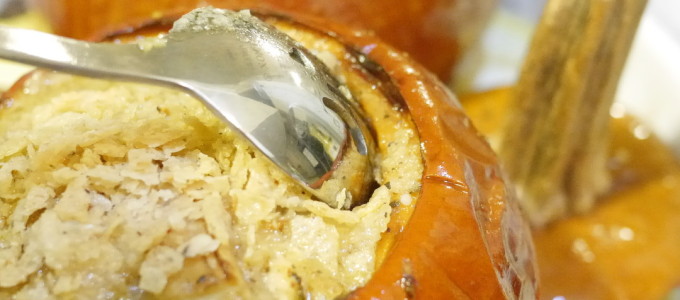
Sausage-Stuffed Squash

I didn’t grow up eating a lot of pork. I’m Jewish, yes. But that’s not the reason. My father was in the Navy during World War II, you see. And while he was shipboard, as he described, it, we would eat everything that was good, first. And then, all that would be left were the pork chops. And it would be pork chops and pork chops and pork chops for weeks at a time. And my father learned to loath pork — except for bacon. And so really, we never had a whole lot of pork products in the house when I was a kid — except for bacon.

Living (and cooking) on my own for the first time, pork was kind of a revelation. I was a vegetarian for the first several years of my transition to cooking for myself. But then it was prosciutto. And then it was Italian sausages. Then meatballs. Then the wonders of a pork chop cooked actually to the right temperature. And pork sort of took off for me as the default meat, especially when I want to use just a little meat to give a dish a lot of flavor.

I’m given to understand, from the reading of other blogs, that my attachment to fine swine is hardly uncommon. Others, it seems, may even like the fruit of the cloven hoof more than I. But sometimes, I’ll make something that is, lets say, pork overload. And far from shying away, I am shocked to find myself reminded of that initial piggy revelation.

This is one of those dishes.

2 Small Winter Squash (like sugar pumpkins, or some such) halved and scooped out
1.5 lb Country Sausage, removed from its casing and cut up small (if you’re in the mid-Atlantic, the Amish do this really well)
1 lb Smoked Country Sausage, cut up small (again, Amish time)
1/2 lb Collard Greens (or kale), stemmed and chopped coarsely
4 Cloves of Garlic
1 Onion, Diced
1 cup Cooked Brown Rice (a generous cup)
2 tsp Dried Sage
1 tsp Rosemary
1 tsp Thyme
1 tsp Parsley Flakes
Salt
Pepper
Olive Oil

Preheat your oven to 400F. Arrange the winter squash halves open side up in a roasting pan, rub them with olive oil, and season with a little bit of salt and pepper. Roast for 20 minutes (until they are about one third of the way cooked), then remove from the oven and set aside.

While the squash are pre-cooking, heat a sauté pan on the stove over a medium flame. Add olive oil, the diced onion, and a little salt, and cook until the onion is translucent. Add the garlic, sage, rosemary, thyme, and parsley, and cook for another two minutes. Add all of the sausage, and cook until the country sausage is about three quarters of the way done (about 10 minutes). Add the chopped collards, and cook with a lid for about ten more minutes (until the collards have wilted). Then add your cooked rice, season with salt and pepper, mix everything well, and spoon as much filling as will fit into each of the four squash halves.

Place the squash back in the oven, and cook until the shells offer no resistance when poked with a knife, and the top of the filling is a medium brown (about an hour).

Braised Short Ribs

I can’t say that I have much of a story to tell here. But I will offer a word of unsolicited advice.

Should you ever happen to go to a reputable restaurant, and should you, on the menu, ever happen to have a choice between a tender fillet mignon and an off-cut — a short rib, or an oxtail, or something of that ilk — always choose the off-cut. Steaks are a dime a dozen. But good braised beef, now. That’s a meal to remember.

I’d like to tell you that it’s a matter of opinion. But it’s not. I’d like to tell you to take my advice with a grain of salt. But you shouldn’t. Unless you have (for some inexplicable reason) ended up at a top-flight steakhouse, the off-cut will likely be more flavorful than the steak, and it will definitely be less boring.

Just make sure it’s a reputable restaurant. Bad braises are bad.

4 Beef Short Ribs
3 cups Red Wine
2 Onions, sliced
2 Ribs of Celery, cubed
2 Medium Carrots, cubed
3 Bay Leaves
3 Cloves of Garlic, crushed
1 tbsp Crushed Red Pepper
1 tsp Thyme
1 tsp Thai Fish Sauce (or finely chopped anchovy)
Salt
Pepper
Olive Oil

Preheat your oven to 250F. On the stove, heat a dutch oven over medium-high heat, with a little bit of olive oil. Season the short ribs with salt. When the dutch oven is very hot, carefully place the short ribs inside, browning on every side for about three minutes. Then remove to a plate.

Turn the burner to medium. To the dutch oven, add the onions, celery, carrots, thyme, crushed red pepper, ground black pepper, and a little bit more salt, and cook until the onions start to brown. Then add the bay leaves and garlic, and cook for about two more minutes.

Return the short ribs to the dutch oven, nestling them down among the onions. Add wine (it should come a bit more than three quarters of the way up the sides of the ribs). As soon as it begins to simmer, place the top on the dutch oven, and put it in your pre-heated oven for three hours.

At the end of the three hours, remove the dutch oven from your oven, and remove the short ribs to a serving plate (be careful, they will want to fall apart). Strain the braising liquid into a second saucepan, add the fish sauce, and boil over high heat until the liquid has reduced by more than half.

Pour the liquid (now a sauce) over the short ribs. And serve, accompanied by rice or mashed potatoes.