Tag Archives: indian

Planning for Thanksgiving

Just for the record — so that I am sure to give credit where credit is due — you must understand that the photos in this post are not — *NOT* — of my own, personal Thanksgiving supplies. They are courtesy of the content of our local Whole Foods Market. Seen there. Not bought. Just so we understand each other.

Now that we’re clear …

***

Thanksgiving is my holiday. It’s a little bit odd, seeing as how I’m the youngest of my family. Seeing as how I live far away. Seeing as how Philadelphia is cold in November, while sunny Southern California, where most of my family resides, is — well — sunny. But I’ve been doing Thanksgiving for most of my adult life. In college, it was as a refuge for students who couldn’t go home. Then it was for family and friends. Then, for the past couple of years, it has been mostly a family affair. Sarah and I got married on Thanksgiving, which makes it a sort of anniversary thing. And the fact is, I make a pretty damn good turkey.

The problem is that while I love doing Thanksgiving — while it’s a great excuse to cook for ten, or twelve, or once almost forty people — traditional fare is kind of a drag. Even a pretty damn good turkey is still really, really a turkey. It’s tasty, more or less, but the trick is not to make it good so much as to pick out a good one, then not screw it up. Then there’s the mashed potatoes, the gravy, dressing, some simple vegetable, bread, and pie for dessert. It’s all fine as far as it goes. But it’s so wholesome. So … boring.

Every so often, I’ll get it into my head to spice things up. One year, I did a turkey, then aloo gobi, pumpkin curry, and saag paneer. Want to guess how that turned out? That was the year that one friend brought her boyfriend, who was astonished that we didn’t have sweet tea, and actively offended by our lack of a working television. Apparently, there was some kind of game or something? Maybe? That was the year that another friend’s significant other walked outside to smoke a cigarette. And decided to stay there. And that was the year that my mother — at least I think it was my mother — took me aside and told me: Adam. Listen. Next year, why not take Thanksgiving off?

And so, duly chastised for my Indian-style transgression, subsequent Thanksgivings have been slightly less adventurous affairs. There were some glazed carrots one year, because they’re Sarah’s grandmother’s favorite. There was a pumpkin cheesecake, kindly supplied by my good, dear friend Beth. But that’s about as daring as it got.

And this year, I worry, is not going to be terribly much better. I’m feeling the itch again — the call of adventure. I’m looking to stray from the path, if only just a little. But for the most part, I fear that my audience will not be receptive. They seem to have some pretty strong ideas about what components are required for a meal to properly be called Thanksgiving. Plus my mother will be there. And she remembers my last Thanksgiving experiment.

So if I want to stray — and I do! — It will have to be subtle. No substituting leg of lamb for turkey, or making individual game hens (yum!). No fish, or gnocchi, or spaghetti and meatballs. Maybe something more like … changing the seasonings. Or playing — slightly — with dessert. I have already been warned — by more than one incoming guest — that pumpkin pie ice cream is no substitute for pumpkin pie. And that cranberry sorbet, while a perfectly acceptable palette cleanser, is no kind of dessert at all. And so I am left with a quandary: how do I bring that Thanksgiving excitement to the table, without also bringing on moans of bitter, bitter disappointment?

This is where you come in, gentle readers. What I propose to do here is give you two menus — one for the Thanksgiving meal itself, and one for brunch (which I have traditionally made for guests the next morning). And what I would like are suggestions — ideas for where I can tweak, shift or replace items to add a bit of variety, a bit of fun. If you like, we can make a game out of it — Plan My Thanksgiving! I can’t offer prizes (alas!). But good suggestions will earn my everlasting gratitude. For whatever that’s worth. So …

Thanksgiving Meal:

  • Butternut Squash Soup with Roasted Walnuts
  • Green Salad with Balsamic Vinaigrette
  • Turkey (stuffed with apples, onions, and prunes for flavor)
  • Gravy (made from drippings, plus said apples, onions, and prunes)
  • Garlic Mashed Potatoes (perhaps with cheese, perhaps with a bit of truffle oil)
  • Bread Dressing
  • Kale Cooked with Bacon
  • Dinner Rolls
  • Pumpkin Pie
  • Vanilla and / or Pumpkin Ice Cream

Morning-After Brunch:

  • Multigrain Pancakes
  • Turkey Hash
  • Bacon and Sausage
  • Fruit Salad
  • Coffee
  • Giant Pitchers of Bloody Mary

As you can see from the squash soup, I’ve already changed some things up a tiny bit. But still: help!

Naan

Indian breads, it seems, are bound to become a series on this blog.  Not that it’s a surprise.  They’re scrumptious, they’re easy to make, and they’ve long been a favorite meal accompaniment — and utensil — of mine.  I don’t have a tandoor (much to my lasting woe), but as I wrote in my Roti post, a super-hot skillet, and an open gas burner, will get you ninety percent of the way there.

Today’s bread is Naan.  A standard of American Indian restaurants, it’s something I’ve been toying with for a while, but I’ve been unwilling to give away the recipe because versions that I’ve made have not felt “Indian enough,” or they have yielded doughs that are extraordinarily frustrating to work with, or both.  Inspired, however, by a friend who’s been using me as a guinea pig to test out some curry recipes, I thought that I’d give Naan another try.  I did some research, converted a bunch of imprecise volume-based recipes into weight, and I think that I’ve come up with a formula that’s good enough to share.

The optimum hydration level for naan, it seems, is about 70%.  Which means, in baker’s terms, that for every unit of flour you add to your dough mixture, you must include 0.7 of a unit of liquid, whether water, or milk, or yogurt, or something else.  It’s a little bit esoteric, I know.  But once you get used to it, working by baker’s percentages make complex breads much, much easier to formulate.

For more info on baker’s percentages, have a look here.  Though understanding the math of it isn’t actually all that important.  Really, having a good kitchen scale is what matters for this recipe (and for almost any of the breads I post here).

250 grams AP White Flour
100 grams Wheat Flour
135 grams Yogurt
120 grams Water
10 grams Oil (or melted butter)
1 tablespoon Granulated Sugar
1 teaspoon Salt
1/2 teaspoon Rapid-Rise Yeast

You can do this by hand, but it’s a sticky job, so I’d recommend using a stand mixer …

Add all the ingredients to your bowl, and let the stand mixer do its thing on low.  Once your mixture comes together into a dough, bring it up to low-medium, and let it knead for about ten minutes.  When the dough has smoothed in texture and become elastic, form it into a ball, place it in an oiled bowl, cover with plastic wrap (or a pot lid), and allow to rise for four hours.

At the end of the four hours, heat a cast iron skillet on high, and turn a second burner to high as well.  Turn your dough out onto a floured board, punch it down just a little, form it into something resembling an even rectangle, and use a knife (or optimally, a dough scraper) to divide it into six even pieces.

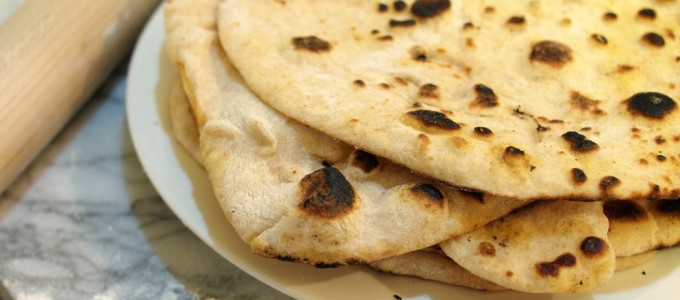
One at a time, use a rolling pin to roll each ball into a thin, teardrop-shaped sheet.  Spray a little bit of oil onto the cast iron pan, and cook each naan for about one minute per side.  Then flip each naan onto the open burner.  Leave it for about thirty seconds.  It should puff up, smoke, and start to burn.  When it does, flip it over, and leave it for another fifteen seconds or so.  Then remove to a towel-covered plate to keep warm.

Optionally, for that rich, rich restaurant taste, when you’re ready to serve, brush each piece of naan with a little bit of clarified butter (ghee).

This is, admittedly, more involved than making roti.  It takes some planning — and about a half hour in the middle of the day to make the dough and give it time to rise.  But the result is worth it — soft on the inside, crispy and slightly toasted on the outside, and the perfect accompaniment to homemade curry.

Roti

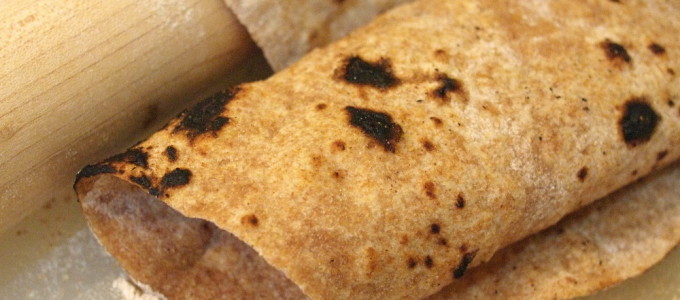
Roti is so very easy, and so very very good with everything from fried chicken, to kabob, to curry.  For those who don’t know, roti is the simplest of the Indian flatbreads, made from whole wheat (atta) flour, water, and salt.  It is eaten all over South Asia (and apparently, in certain parts of the Caribbean).  And what distinguishes it is that it is unleavened.  Which means no yeast.  Which means no rise.  Which means that it can be ready in the time that it takes to prepare the rest of your meal.

So … how do you do it?  Simple.

2 cups Whole wheat Flour
1 cup Water
1 tsp Salt
Spray oil

Mix the flour, water, and salt in a bowl, knead for five minutes, and allow to rest for about an hour so that the flour can hydrate (during this time, I like to msake a curry, or do some dishes, or read a novel).

When the hour is up, heat a cast iron skillet on high, and turn on a second burner, also on high (you’ll see why in a minute).  Divide the dough into six walnut-sized balls.  Flour a board, and one at a time, roll each ball into a very thin disk.  Add a little bit of spray oil to the cast iron pan, and cook each disk about one minute on each side.  Then flip the disk onto the open burner.  It should puff up almost immediately.  Leave for about 30 seconds, then flip, and allow it to sit on the open burner for another fifteen seconds or so.  Then remove to a towel-covered plate to keep warm.

All told, once the dough is made and rested, it takes me all of about ten minutes to roll, cook, and puff a serving of six roti.