Tag Archives: cheese

Mascarpone Ice Cream

It isn’t crazy that this morning — on the first real snowy morning of the new year, with three inches of snow on the ground, having just come in from shoveling the front steps — I churned two batches of ice cream. It’s not crazy at all. Not in the least. I mean it.

The fact of the matter is that I’ve gotten myself involved in this thing — a winter CSA. During the summer, Lancaster Farm Fresh Cooperative — the organization from which we get our CSA — offers an excellent vegetable share. We get greens and eggplant, tomatoes, okra, and all manner of other goodies. It’s all very fresh and very healthful. And I’ve talked about this here before.

But there’s a winter option, too, being offered for the first time this year. And because, obviously, they can’t offer quite the array of green vegetables that they do in the summer — because it’s all, by necessity, onions and potatoes and a scattering of hothouse lettuce — they have to do something to make up the difference. So we had a choice about what else we wanted when we signed up for the CSA. And I chose a quart of raw goat’s milk. Every two weeks.

You begin to get the picture about the ice cream, then. Yes?

A quart of raw milk, whatever its animal of origin, is the sort of thing that needs to get used up pretty quickly when it comes into the house. Because it’s not pasturized, or ultra-pasturized, it doesn’t have the shelf-life of grocery store milk. Even refrigerated, it only lasts a week. Tops. It’s oh, so good — so much richer and subtler than grocery store milk. But there’s no way I can drink it all in such a short span. So a couple of servings end up on top of cereal. And the rest has to be preserved. In this case, in the freezer. As ice cream.

Now, I can imagine some of your reactions already: Goat’s milk ice cream? Uck! But seriously, folks. Don’t knock it until you’ve tried it. Goats aren’t like cows. Their milk is less fatty overall, but what fat it has tends to stay in the milk rather than floating to the top as a layer of cream. Which means that it’s richer when you drink it. Sometimes, it’s almost too rich. But that, precisely, is what makes it perfect for ice cream.

So here’s what I did: I made two flavors — mango (from store-bought juice), and mascarpone cheese. The first one, the Mango, is still a bit of a work in progress. It came out well, but there were some technical issues with my ice cream maker, and I don’t want to share the recipe here until I get them worked out.

The second one, though — the Mascarpone — turned out super tasty. With lemon zest and just a hint of vanilla, it’s got sweet, it’s got tangy, it’s got creamy, and it’s got that peculiar richness that makes cheese in ice cream so very good. I’m not going to say that it’s the best cheese ice cream that I’ve ever had. My friend Linda’s homemade ricotta ice cream, made from homemade ricotta, holds that distinction beyond any doubt. But without any eggs, it’s dead simple to do. And served, perhaps, drizzled with some melted Nutella, it’s not a dessert that you or your guests will soon forget.

8 oz Mascarpone Cheese
2 cups Milk
1 cup Heavy Cream
1/2 cup Granulated Sugar
1 tsp Vanilla Extract
Zest of Two Lemons

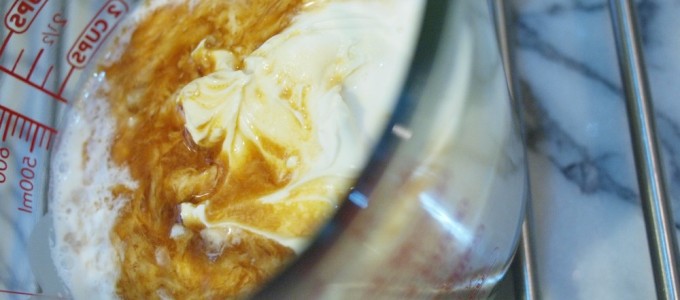
In a chilled bowl, combine the cheese, cream, and vanilla, and whisk until the mixture is fairly smooth. Then set aside.

In a saucepan over low heat, combine the milk, sugar, and lemon zest, and allow the mixture to come to a simmer (about 190F), stirring occasionally. This should take about half an hour.

Pour the hot milk through a sieve onto the cold cheese-cream mixture. Mix well with a whisk, chill thoroughly, then pour into your ice-cream maker, and freeze according to the manufacturer’s instructions.

Caramelized Onion Tart

I intended to make a peach galette for dessert Friday night. I really did. It would have been sweet and tangy, rustic, crusty, and glazed with homemade jam that my friend Linda had gifted me a couple of months back. I had the dough for the crust ready and everything. But then I went and inspected this week’s peaches, and I found that while I hadn’t been looking, they went from slightly too crunchy to moldy, saggy, and oozing, with hardly a moment of perfect ripeness in between.

Distraught, and lacking for backup fruit, I groped for a plan B. I couldn’t abandon the idea of a pastry. I had made all this shortcrust dough, and it wouldn’t due to throw it out, or to let it languish in the fridge until I could get more peaches. And so, casting my eyes around the kitchen, I settled on the only other produce I had in abundance at the time — onions.

Onions and peaches, when you think about it, are not actually all that different. Sure, they are in the absolute sense: one is a stone fruit while the other is a bulb; one has a fuzzy skin while the other’s is papery; one makes my eyes water with pleasure when I bite into a perfect specimen, while the other … well … just makes my eyes water. But they are not actually all that different. Fundamentally. At their core. In their most important facet. Which is to say that they both make really excellent filling for a tart.

So. Change in plan. Instead of sweet, savory. Instead of rustic, formed. Instead of dessert, side dish. And I think to myself: you know, this isn’t actually such a bad thing. Beef is tonight’s main event, after all. And what goes better with beef than caramelized onions, and maybe some burnt cheese? French onion soup, anyone?

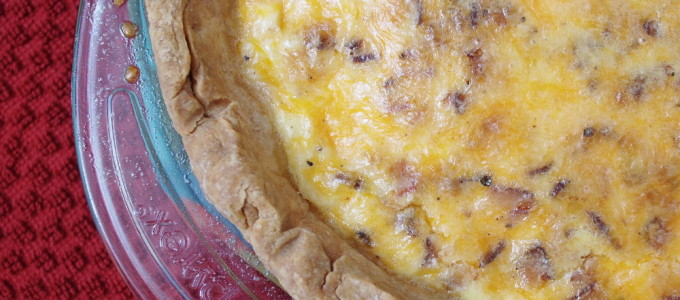
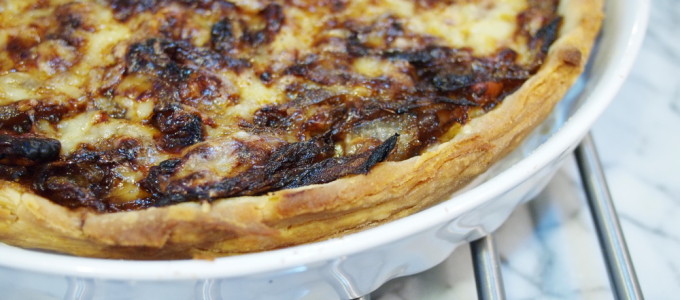
From the high shelf, I brought down my trusty Ikea-brand tart pan. I pulled out the slicing knife and the cheese grater. And with barely a pause to adjust my baking expectetions, I got to work. Bake, bake, bake. You know how it is. And in the end, given what came out of the oven, I defy you to notice that this caramelized onion tart was not the dish I had intended to make. It was postcard perfect, which was a little bit of a surprise given my recent history of ugly tarts. And it stole the show at dinner, drawing oohs and aahs away from the otherwise perfectly respectable braised short ribs that, on any other night, would have been a star.

I’m not bragging here, you understand. It simply turns out that this was one onion tart to remember.

At any rate, here’s how you do it. Like with most pastry, there are a lot of steps. But each one is easy. And if you spread them out a little bit, putting it all together is no problem at all.

Crust

1 1/4 cup Flour, plus some for sprinkling as you roll out the crust
1 stick Butter, chilled and cut into cubes
1 tbsp White Sugar
1 Egg + 1 Egg Yolk
1 tbsp Water
Salt

Filling

5 Medium Onions, sliced
1 cup Freshly Grated White Cheddar Cheese (Choose a good Cheddar. It matters.)
1/2 cup Raw Pecans
1 tbsp Balsamic Vinegar
Olive Oil (or Butter)
Dried Thyme
Salt
Pepper

The night before you’re ready to make the tart, make the dough for the crust. To a food processor, add your flour, sugar, salt, and butter, and pulse until there are no more big chunks of butter, and the mixture looks a bit sandy. Add the eggs and pulse. Then, if needed, add as little water as you possibly can to make the mixture come together into a dry dough. You may need no water, or you may need the whole tablespoon. Either way, you want the dough to be at the stage where it is just barely holding together.

Once you’ve done this, form your dough into a disk, wrap in plastic wrap, and refrigerate overnight.

The next day, when you’re ready to make the tart, preheat your oven to 400F. Roll out the shortcrust into a 13-inch circle, lay it into a tart pan, press it into the corners, and trim the excess dough with a paring knife. Pierce the bottom all over with a fork (to prevent air bubbles while baking), and refrigerate for at least 20 minutes (to allow the gluten in the flour to relax).

After 20 minutes, line your tart shell with foil or parchment, fill with pie weights (or dried beans, or my favorite, uncooked rice), blind bake for 10 minutes, and then set the partially baked shell aside.

While the pastry is resting and blind baking, prepare the filling. Grate the cheddar and set it aside. Heat a heavy-bottomed pan with a little bit of olive oil over medium, and slice up the onions. Add the onions to the pan, add salt and pepper, and allow to cook for 40 minutes to an hour, stirring occasionally, until their moisture has evaporated and they begin to caramelize. About ten minutes into cooking the onions, add the balsamic vinegar and dried thyme, and continue to stir. Be patient. There is a lot of moisture in 5 good-sized onions, and most of it needs to evaporate before you can get caramelization.

Once you get some caramelization, add the pecans, stir, cook for about five more minutes, then remove from the heat and set aside.

Once the filling is done, it is time to put the tart together. Sprinkle about half of the grated cheddar on the bottom of the pastry shell. Add the onion-pecan mixture, and smooth it out such that it evenly fills the tart. Sprinkle the rest of the cheddar on top. And bake in your 400F oven for 30-40 minutes — until the crust has browned and the cheese on top is just starting to burn.

Like I said. There are a lot of steps. But none of them is hard. And I guarantee, as a side dish with dinner or as a non-egg alternative for brunch, this tart is well worth the trouble. The sweetness of the onions, the savoriness of the cheese, the flakiness of the crust, and the toastiness of the pacans will make even your most onion-hostile guests jump for joy.

Cheddar-Scallion Scones!

When writing wasn’t going well this afternoon, I gave up and made scones. They’re loosely based on Mark Bittman’s super-fabulous scone recipe from the New York Times, only they’re not at all the same. They are just as easy, however, and take no more than 45 minutes from mixing bowl to plate. So check it out:

1 1/2 cups All Purpose Flour
1/2 cup Whole Wheat Flour
1 tsp. Salt
2 tsp. baking powder
1 Tbsp. sugar
6 Tbsp. very cold butter, cut into small cubes.
1 egg
3/4 cup yogurt
4 scallions, chopped finely
1/2 – 3/4 cups of shredded cheddar cheese, plus some for topping the scones
black pepper and cayenne pepper to taste

Preheat the oven to 450F. Place the flour, salt, baking powder, sugar, pepper, cayenne, and butter in the work-bowl of a food processor, and pulse the mixture gently until the butter has disappeared and the flour looks sandy. Don’t over-pulse. As with pie crust, you don’t want to develop gluten.

Beat your yogurt and egg together briefly, then add it to the work-bowl along with the cheddar and scallions, and pulse just a couple more times, until you have a gooey mess.

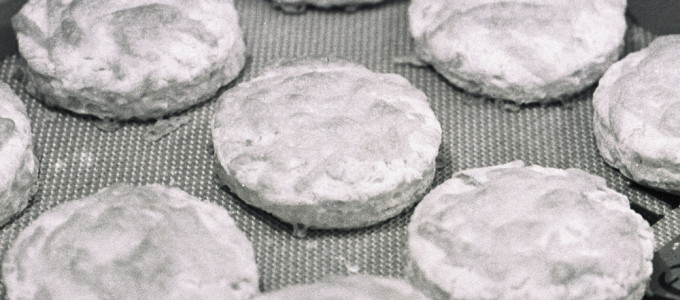
Turn the mixture out on a floured board, and use a rolling pin (or, really, your hands) to roll it out until it is about a bit less than a half inch thick. Then use a cookie cutter (or drinking glass) to cut out rounds, placing them on a lined cookie sheet.

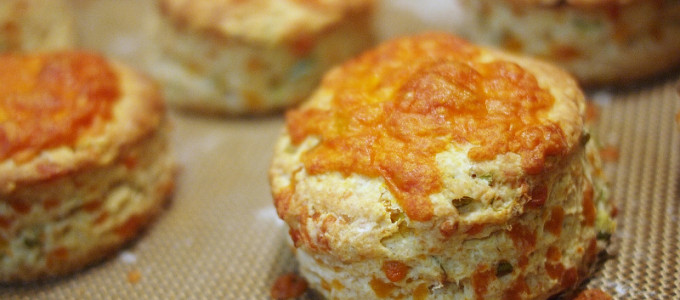
Finally, top each round with just a little bit more shredded cheese, and place them in the oven for 24 minutes, or just until the cheese on top has gone from melted to crispy.

Aged Mimolette Brioche

I decided last week that I wanted to do a cheddar brioche in the style of Caffe Strada in Berkeley. I used to love them; they were my breakfast or lunch more often than I would care to admit. But when I went looking for the right cheddar for the project, I came upon Mimolette cheese instead. It was a crumbled yellow cheese that I had never had before, but it smelled so good that I just couldn’t resist. So I picked it up for this project, and while I haven’t eaten much of the brioche just yet, it seems to have worked out pretty well overall.

For the dough, I used Peter Reinhardt’s recipe for Middle Class Brioche in The Bread Baker’s Apprentice. I screwed up and ended up using salted butter instead of unsalted, but with the cheese, I don’t think that it’s very noticeable.

Anyway, here’s a picture. Mmmm….