Tag Archives: lemon

Mascarpone Ice Cream

It isn’t crazy that this morning — on the first real snowy morning of the new year, with three inches of snow on the ground, having just come in from shoveling the front steps — I churned two batches of ice cream. It’s not crazy at all. Not in the least. I mean it.

The fact of the matter is that I’ve gotten myself involved in this thing — a winter CSA. During the summer, Lancaster Farm Fresh Cooperative — the organization from which we get our CSA — offers an excellent vegetable share. We get greens and eggplant, tomatoes, okra, and all manner of other goodies. It’s all very fresh and very healthful. And I’ve talked about this here before.

But there’s a winter option, too, being offered for the first time this year. And because, obviously, they can’t offer quite the array of green vegetables that they do in the summer — because it’s all, by necessity, onions and potatoes and a scattering of hothouse lettuce — they have to do something to make up the difference. So we had a choice about what else we wanted when we signed up for the CSA. And I chose a quart of raw goat’s milk. Every two weeks.

You begin to get the picture about the ice cream, then. Yes?

A quart of raw milk, whatever its animal of origin, is the sort of thing that needs to get used up pretty quickly when it comes into the house. Because it’s not pasturized, or ultra-pasturized, it doesn’t have the shelf-life of grocery store milk. Even refrigerated, it only lasts a week. Tops. It’s oh, so good — so much richer and subtler than grocery store milk. But there’s no way I can drink it all in such a short span. So a couple of servings end up on top of cereal. And the rest has to be preserved. In this case, in the freezer. As ice cream.

Now, I can imagine some of your reactions already: Goat’s milk ice cream? Uck! But seriously, folks. Don’t knock it until you’ve tried it. Goats aren’t like cows. Their milk is less fatty overall, but what fat it has tends to stay in the milk rather than floating to the top as a layer of cream. Which means that it’s richer when you drink it. Sometimes, it’s almost too rich. But that, precisely, is what makes it perfect for ice cream.

So here’s what I did: I made two flavors — mango (from store-bought juice), and mascarpone cheese. The first one, the Mango, is still a bit of a work in progress. It came out well, but there were some technical issues with my ice cream maker, and I don’t want to share the recipe here until I get them worked out.

The second one, though — the Mascarpone — turned out super tasty. With lemon zest and just a hint of vanilla, it’s got sweet, it’s got tangy, it’s got creamy, and it’s got that peculiar richness that makes cheese in ice cream so very good. I’m not going to say that it’s the best cheese ice cream that I’ve ever had. My friend Linda’s homemade ricotta ice cream, made from homemade ricotta, holds that distinction beyond any doubt. But without any eggs, it’s dead simple to do. And served, perhaps, drizzled with some melted Nutella, it’s not a dessert that you or your guests will soon forget.

8 oz Mascarpone Cheese
2 cups Milk
1 cup Heavy Cream
1/2 cup Granulated Sugar
1 tsp Vanilla Extract
Zest of Two Lemons

In a chilled bowl, combine the cheese, cream, and vanilla, and whisk until the mixture is fairly smooth. Then set aside.

In a saucepan over low heat, combine the milk, sugar, and lemon zest, and allow the mixture to come to a simmer (about 190F), stirring occasionally. This should take about half an hour.

Pour the hot milk through a sieve onto the cold cheese-cream mixture. Mix well with a whisk, chill thoroughly, then pour into your ice-cream maker, and freeze according to the manufacturer’s instructions.

Lemon-Rosemary Scones

Sarah and I have a grand weekend tradition of eating breakfast out. We’ve been doing it almost as long as we’ve been together. First, it was at the Original Mel’s in Berkeley, then the Runcible Spoon in Bloomington, and now … it’s wherever we can manage here in Philadelphia. We’re fans of restaurant dining, generally — of food made to order, of eating amidst the din and clatter of other groups at other tables. But our breakfast tradition is really less about the experience of the restaurant, per se, than it is about the idea of breakfast being leisurely — of it being a time to talk, sip coffee, eat bacon, and let the world recede around us, if only for a little while.

Circumstances, though, are such that going out to breakfast is sometimes neither plausible nor desirable. Sometimes we awaken too early or too late. Or we feel that we’ve done too much eating out, or that it’s too cold outside, or that the idea of facing mediocre breakfast — the majority of breakfast (alas!) in our neighborhood — is not very appetizing at all.

Sometimes we want to stay in. But cereal for breakfast, on a weekend, is just so very sad.

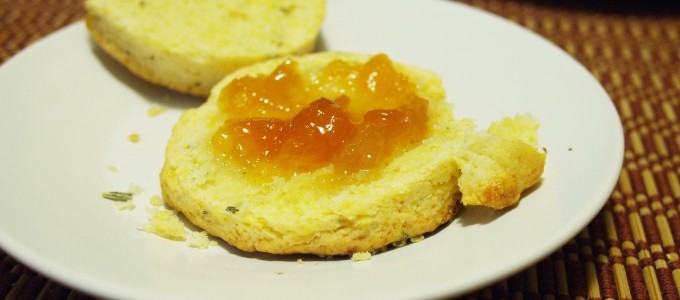
Today was one of those days. It was a morning when the timing, the weather, everything lined up against the notion of leaving the house. And so I crept downstairs, early but not too early, pre-heated the oven, and put together some scones.

The base recipe for these scones is not mine. It’s a Mark Bittman dealy that appeared in the New York Times a year-and-a-bit ago. But the combination of flavors is mine. And I’ve made some important modifications, especially to cooking time, that take these scones from pasty and slightly raw tasting (a common scone problem) to toasty and delicious.

They’re super easy, at any rate. And they can be done, start to finish, in under 40 minutes. How can you not want to make them for breakfast?

2 cups AP Unbleached Flour
1 Egg
1 Stick of Unsalted Butter, chilled and cubed
1/2 cup Heavy Cream
3 tbsp White Sugar
2 tsp Baking Powder
2 tsp Dried Rosemary, crushed
1/2 tsp Salt
Zest of 2 Lemons

Preheat your oven to 450F, and line a cookie sheet with parchment.


To the bowl of a food processor, add the flour, sugar, baking powder, and salt, and pulse a couple of times to mix. Add the lemon zest, rosemary, and butter, and pulse in five-second bursts until there are no more chunks of butter, and the mixture has a texture like sand. In a second bowl, beat the egg and cream together, then add to the food processor, and pulse again, again in five-second bursts, until the dough just barely comes together.

At this point, turn your dough out onto a floured pastry board, shape into a rectangle, and using a floured rolling pin, roll the dough out evenly until it is a half-inch thick. Use a round cookie cutter (or the mouth of a glass) to cut out two-inch disks, spacing them evenly on your lined cookie sheet. Then re-form the left-over dough, re-roll, and cut again. You should get 8-10 rounds in all.

Once the rounds are cut, top each scone with a little bit more cream (to add color and sheen once they are cooked), and a sprinkle of additional white sugar. Bake for 20-25 minutes, until the tops are golden brown and just starting to darken around the edges. Then remove from the oven and eat while hot.

I never get tired of these.