Tag Archives: pasta

Pasta with Collards and Bacon

When is he going to make another post about collards?

I know, I know — that’s the question that’s been on all of your minds. You can’t resist those broad leathery leaves, dark green in both look and smell. You can’t resist that bitter taste, or that extensive history, or that big shiny 1000 on the ANDI scale.

The answer, of course, is right now. I’m going to make another post about collards right now. And it’s going to be a quick-and-dirty one. Because I’m headed out of town on an academic errand, and I have so very much to do before I leave.

So here it is — pasta with collards and bacon. This is a recipe, dear readers, that takes one of the finest foods ever imagined and … and adds some greens to it.

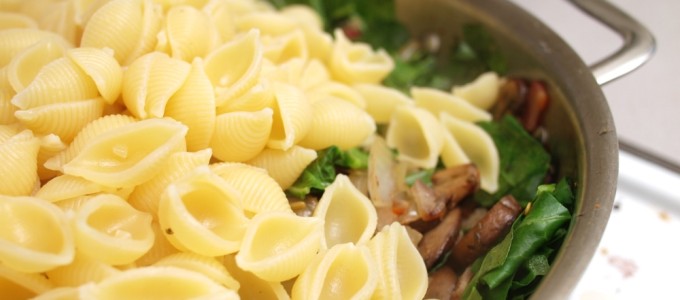
1 lb Extruded Pasta (I used shells this time, but I’m fond of this with ziti or gemelli, too)
1/2 lb Bacon, diced
2 Bunches of Collards, stemmed and chopped
2 Medium Onions, sliced
1 quart Mushrooms, sliced
5 Cloves of Garlic, minced
1 tsp Oregano
1 tsp Crushed Red Pepper
1/2 tsp Thyme
1/2 tsp Fennel Seeds
Parmesan Cheese
Pepper
Salt

Fill an 8-quart pot with water, add ample salt, and set it on the stove to boil. Meanwhile, to a sauté pan over medium heat, add the diced bacon and allow to cook, stirring occasionally, until almost crispy. Then remove the bacon with a slotted spoon. To the leftover grease, add the sliced mushrooms, along with a little bit of salt, the thyme, the fennel seeds, and the red pepper flakes, and cook for about 5 minutes, just until the mushrooms start to brown. Then add the onions, along with a little bit more salt, and cook for about 20 minutes, until the onions have mostly softened.

At this point, your pasta water should be boiling. To the sauté pan, add the minced garlic, the dried oregano, pepper to taste (I like about thirty turns of the grinder), and the cooked bacon. Cook for about five minutes, stirring constantly to make sure that the garlic does not burn. Then, add the chopped collard greens to the pan, closing the lid. And add your pasta to the boiling water.

As the greens begin to wilt, you’re going to want to stir occasionally to mix them in with the rest of the ingredients. I have found that a good pair of tongs is best for doing this.

At the end of about ten minutes, when the pasta is al dente and the greens are cooked, drain the pasta (not too well. A little bit of pasta water does wonders for this dish!) and add it to the saute pan. Add the Parmesan cheese and a bit more salt and pepper (to taste), and mix thoroughly. Allow the entire dish to cook together for five more minutes, to allow the flavors to blend. And then serve while hot.

Enjoy!

The Unbelievable Nardello

Most of the content I’ve posted here so far has come in the form of recipes.  But it occurs to me that ninety percent of the cooking that I do is recipe-free.  I start with a couple of ingredients that I think would go well together, I cook them up in some predictable way, we eat the results, and more often than not, it is delicious.  The preparation isn’t special.  But while I sometimes like high-maintenance cooking (as evidenced by almost everything else on this blog), I don’t generally think that preparation should be special.  Call me a product of NorCal cuisine if you’d like, but if I had to articulate one cardinal rule of cooking, it would be this:

Use the best, freshest ingredients, don’t do too much, and try your best not to screw them up.

Enter the Nardello Pepper.  This, my fine friends, is the best.  They’re not very common — Slow Food USA, in fact, has listed them as an “endangered” variety.  But they offer an almost-overwhelming fruity sweetness that, when cooked, becomes creamy and complex and unlike any nightshade that I’ve ever eaten before.  They’re not un-pepper-like.  If anything, they are preternaturally pepper-like.  They are more sweet-peppery than the bells, the gypsies, the banana peppers that you usually see around.

I don’t know if they can be found commercially.  I have them because Sarah has been growing them in her vegetable garden since we moved to Philadelphia.  The seeds come from Southern Italy, and were brought to the United States — to Connecticut, specifically — by the Nardello family in the 1880s.  Since 1980 or thereabouts (I am given to understand), they have gotten out and around, and have become increasingly popular with home gardeners.  And even if the pepper itself isn’t found for sale very often, the seeds are widely available, including here, at Seeds of Change, and here at the Seed Saver’s Exchange.

I am the opposite of a gardener, I think, which makes me unqualified to talk about the technicalities of how they grow.  But every year Sarah plants them, and every year we get good yields.  So my impression is that if you want to plant a few, they aren’t that hard to get right.

While I don’t know what to do with them in the yard, though, I know just what to do with them in the kitchen.  These peppers were made to be cooked with onions, to be slathered on sandwiches, or draped over pasta.  And that is what I would recommend.

I would recommend slicing a large onion, and tossing it into a frying pan with olive oil, dried oregano, fennel seed, salt, pepper, and a small can of tomato paste.  Cook until everything (especially the tomato paste) starts to brown, then add sliced Nardellos (along with any other peppers you happen to have).  Cook for perhaps ten minutes more until they have softened, then deglaze with a little bit of water (you could use white wine, but remember Rule Number One), and serve with an extruded pasta like ziti.

I sometimes like to add some sliced-up hot Italian sausage to this mix.  I’ve also added kale, whole tomatoes, cubes of fresh mozzarella, broccoli, summer squashes, and green beans, all with good results.

Nardellos are special.  And if you grow them, that’s a caveat as well as a compliment.  You’ll want to grow some other pepper varieties too, because when you’re friends come around asking for produce, and you won’t want to part with any of these.

Stinging Nettle Gnocchi

“This should be the weekend of stinging nettle,” Sarah told me.  “Find something to do with it.”

Months ago, when we were planning our garden for the year, Sarah told me that she would like to get away from growing only nightshades.  For the previous two summers, it had been eggplant, and pepper, and tomatoes (oh my!), and she felt that by relying so heavily on one (disease-prone) family of plants, we were courting vegetal disaster.  So we flipped through the seed catalogue together, and when we happened across stinging nettle, I told Sarah:  “Why don’t you grow that.  I ate it once on a pizza at the Chez Penisse Upstairs Cafe, and it was very tasty indeed.”

Flip forward to this weekend.

The problem with basing a growing decision on the memory of one distant but pleasurable meal at what may be the best restaurant on the West Coast is that though, if I wanted to, I could make a stinging nettle pizza, it would be nowhere near as good as the one in my mind.  Over the years, I have idealized that meal fiercely, and even if I hadn’t, it’s still Chez Panisse, and I am certainly no Alice Waters.  So when Sarah told me that my nettles were ready, I decided, adamantly, that I needed to find something else to do with them.

To the Internet!

I found this fabulous page about making stinging nettle pasta by Hank Shaw.  But I am a pasta novice, and I didn’t want to waste the entire plant on a project that might not turn out.  I found a bunch of off-putting health-food sites about nettle tea, and the burning question of whether it is the next “superfood” (whatever that means).  And then I found mention of something that I could do, and that I wanted to do:  nettle gnocchi.  Gnocchi is easy, it’s delicious, it showcases flavors well, and dead simple as it is, it looks nice and impressive.  So I did some calculating, some recipe-ing, and before long, the decision was made:  stinging nettle gnocchi with sauteed vegetables in brown butter.

Here’s what I did, gnocchi-wise:

3 Large Russet potatoes, peeled, cubed, and boiled until tender
1 Egg
1 1/2 Cups AP flour (amount may vary)
As many nettle leaves as you can get (I had approximately 8 oz.)
Salt

Start by preparing the nettles:  they are called “stinging” for a reason, folks. They have little hairs on their leaves that, when you touch them (or eat them raw), inject you with a dose of formic acid which, according to Hank Shaw, is the same stuff that fire ants use to make you suffer.  Which means that you should always wear gloves when handing the plant or its uncooked leaves.  And raw parts should never come anywhere near your mouth.

The way to get rid of this nastiness is to blanch them.  Get a gallon of water to a rolling boil, add salt until the water tastes briny, give your nettles a two-minute bath, and then swiftly fish them out, and into a bath of ice-water to cool them down and stop them cooking.  As soon as they are cool, pull them out of the water and thoroughly wring the moisture out of them (no gloves necessary, anymore).  They’ll look ugly — like a vivid green mass of mushy spinach.  But they don’t need to be pretty where they’re going.

Once you’ve done that:  add the wrung-out nettles, the potatoes, and the egg to a blender or food processor and whirl until the potatoes are smooth and the ingredients have come together.  Move to a mixing bowl, and a half cup at a time, add the flour, mixing thoroughly.  You’ll want to stop when your mixture starts to look like a sticky dough.  Add too little, and you have mashed potatoes.  Add too much, and your gnocchi will be rubbery.  It seems to me that the best way to judge is by taste.  When it starts to taste just a bit more like raw bread than potatoes, it’s done.

Once you’re dough is mixed, let it rest for an hour or two, and then either roll it out into long logs, and cut it into half-inch segments (the traditional way), or (as I did), scoop the mixture into a gallon ziplock bag with one tip cut off for easy piping.  Either way, bring a new batch of salty water to a rolling boil, add your gnocchi in small batches (one or two dozen at a time), and cook until done.  You’ll know they’re done because they’ll float.  Once floating, give them about 90 seconds, then remove them to a holding area.

Sarah said that she had a hard time tasting the nettle in the gnocchi, especially against the strength of the brown butter sauce.  But I was able to taste it very clearly:  a little bit like spinach, but nuttier, a bit more umami, with a faint oceaniness.

Squash-Blossom Pasta Sauce

I’ve posted a recipe for squash-blossom pasta sauce before, but I’ve done some revising, and wanted to post it again. This came out perhaps better than any other iteration I’ve tried. I would highly recommend it, especially if you are like me and have some overly enthusiastic summer squash dominating your garden.

2 yellow squash, cut into small-ish cubes
2 Dozen squash blossoms
1 cup stock (I used chicken, but veg would be just as good)
1/2 cup heavy cream
2 cloves of garlic, chopped
1 heaping tbsp parmesan cheese
2 tsp. paprika
1/4 tsp. cayenne pepper
Pinch of saffron, steeped in 1/4 cup warm water
salt
pepper
nutmeg
olive oil

Heat a pan with some olive oil over medium heat, and saute the squash until browned. Add the garlic, squash blossoms, paprika, cayenne, and cook for about two more minutes, then add the stock, bring to a boil, and cook for a bit less than 10 minutes more.

Move the whole thing to a blender, add the cream, parmesan, and saffron (with its water), and blend until smooth. Then move back to the pan (now over low heat), and season to taste with salt, pepper, and nutmeg.

Serve with an extruded pasta like ziti, perhaps garnished with some dark red tomato cubes.

A Tale of Two Red Sauces

For almost a year, I’ve considered writing some reflections here about tomato sauce, how to make it, and how to use it to make lots of other yummy things. I’ve dithered and delayed and thought to myself — this is too long and involved to write today. And now, after my experience eating in Greece this summer, I’m really glad I did delay. Because while I was in Greece, I discovered that my usual red sauce — rich, filled with wine and spices, cooked slowly in a Dutch oven over low heat on the stove — is only the tip of the iceberg of tomato possibilities. I discovered that red sauces can be light, fresh tasting, lemony, almost effervescent. I discovered that they can be an accent — a thing that brings out other flavors — rather than a primary flavor in and of themselves.

So rather than writing about one red sauce here, I’m going to write about two — a Jekyll and Hyde, a Janus the two-faced god of what, exactly, tomato-ness means.

The first red sauce, like I said, is my old standard. It is lots of liquid, cooked in a Dutch oven for several hours, reduced in volume to make it thick, rich, almost creamy (though there isn’t a bit of dairy in it). This one is red sauce as the main event. It is the kind of marinara that you would put over pasta, cook with meatballs, use in lasagna, or even better, use in a timpano — that beautiful, browned, crusty, pasta, meat, and vegetable pie that is the centerpiece of Stanley Tucci’s film, Big Night. It’s the kind of big bold flavor that causes other flavors to have to stand up and yell just to be heard.

The second sauce is new hotness. Or it is to me, anyway. I learned this one in Greece. It is lighter than the first, made simply with olive oil, lemon, and oregano, and not cooked very long at all. The result is something that is crisp, clean-tasting. Something that can be the main flavor in a dish, but hardly has to. You could use this one to sauce roasted vegetables, or boiled beans, or even a robust fish, and have the flavors of those main ingredients come through. I’ve used this as a brazing liquid for eggplants and for lamb. I’ve used it as a sauce for grilled pizza where the flavor that I really want to emphasize is the bread. And I’ve used it, more generally, wherever I want something to taste … well … Greek.

To me, the first red sauce is dark and the second is light. The first is a winter night, and the second a summer’s day.

Which brings me to the main question at the center of every red sauce: fresh tomatoes? Or canned? My answer, almost uniformly, is the latter. But it really is a winter-summer thing. If you are making tomato sauce in July or August or early September — if you are cooking at the heart of tomato season, and you have lots of Roma or San Marzano tomatoes growing locally, or growing outside in your back yard — then the answer is obvious. You should skin and seed those tomatoes, and use them to make a nice fresh sauce. But if you are making a red sauce at any other time of year — in November or May or any other month when tomatoes aren’t supposed to grow — even if you can find Roma tomatoes imported from Mexico or Chile in the grocery, go with the canned. Those offseason tomatoes, grown elsewhere or grown in a hothouse, are going to be bland and watery and mealy and altogether a big pile of yuck. But if you’re careful about your canned tomatoes — if you buy the San Marzano kind imported from Italy, or the organic brands from California, you are much more likely to get something flavorful and good, because those tomatoes were picked and canned in the summer, when tomatoes are supposed to be growing. And so they taste like tomatoes should taste. It is odd for me to advise you all thus, because I’m usually against canned anything on principle. But trust me. For all but two and a half months of the year, canned is the way to go.

Now that that’s settled, lets make some tomato sauce.
Continue reading