Tag Archives: lamb

Shish Kofte (Kofte Kebab)

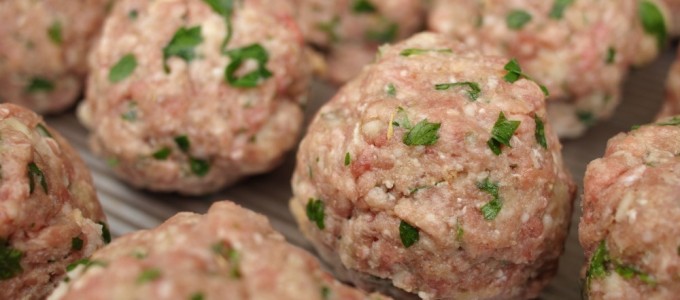
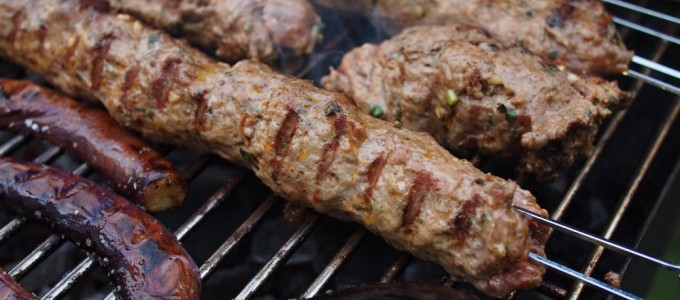
Kofte (or kofta, or köfte, or koobideh) has long been popular across the Middle East, Asia Minor, South Asia, and Southern and Eastern Europe.  In its guise as a spiced-lamb meatball-on-a-skewer, it is a staple of the Turkish grill, found (I am given to understand) on street carts all over Istanbul, and found (I know from experience) in every single Turkish restaurant in the United States.

Depending on where you are, Kofte can mean anything from a giant ball of minced meat (Iran) to something resembling meatloaf, to balls of mixed lentil and potato, with no meat at all, that you would probably recognise if you’ve ever dined in an Indian restaurant.

What we’re talking about here today, however, is Turkish shish kofte (kofte on a skewer).*  And what I hope that you will find is that it’s the perfect off-the-beaten-track grilling item for a party of mixed culinary company — it’s easy, savory, herby, comforting, exotic enough for a wandering palette, and familiar enough that it can be served (as “grilled meatball”) to even your least foodie friends and grandparents.

In Turkish restaurants, you’ll see it served with rice and salad.  But I would suggest accompanying it with flat-bread (I use roti, but pita or lavash might be truer to the style), and eggplant that has been grilled until it is partly blackened on the outside, and molten on the inside.  Some form of hot sauce would not be amiss.  And tzatziki, chunks of feta, lemon wedges, and chopped fresh herbs are all great accompaniments, too.

* Just as a point of clarification: in the places from which such things derive, Shish (şiş, in Turkish) refers to the skewer.  Kebab (or Kabob) refers to bits of meat, sometimes affixed to a skewer and sometimes not, that are grilled or roasted.

2 lbs Ground Lamb
1 tbsp Chopped Fresh Mint
1 tbsp Chopped Fresh Oregano
1 tsp Chopped Fresh Thyme
1 1/2 tsp Paprika
1 tsp Cumin Seeds
1 tsp Ground Sumac (or Lemon Zest, if you can’t find any)
4 cloves Minced Fresh Garlic
Olive Oil
Salt
Pepper

In a mixing bowl, combine all ingredients thoroughly, making sure that the herbs and spices are evenly distributed in the meat, but that meat is not overly mixed (and therefore overly compacted).

Around skewers, form your spiced meat into an elongated tubular shape, “notching” the meat — leaving one section a little bit thinner than the rest — every couple of inches.  I prefer metal skewers for this, because they don’t burn on the grill.  And I prefer to use two skewers at a time, rather than one, because it keeps the meat from sliding around too much during cooking.

Place the skewers of meat on a (preferably charcoal) grill over medium-high heat, and cook for about eight minutes, rotating the skewers every minute or two to make sure that all sides get browned and a little bit charred.

You’ll be surprised by how much meat this makes.  Apportioned right, it will feed five to six guests.

Lamb Shanks and Cubebs

As I’m sure I’ve mentioned here before, I love lamb. I like beef okay if the cut is right, if the cow is right, if the preparation is right. But in almost every circumstance, if you want to please me by serving me red meat, I’d rather have a good piece of lamb. Lamb has a more complex, delicate flavor. It’s a little bit gamy, it’s a little bit sweet, and it tastes a little bit like a grassy meadow. In a good way. And best of all, compared to beef, many of the best cuts of lamb are pretty cheap.

Which brings me to lamb shanks. Shanks, which come from the upper, less desirable portion of the leg, are among the least expensive cuts you can buy. And prepared right, they are among the tastiest. Cooked rare, they are tough — too tough to eat. But the same thing that makes them tough — the connective tissue, the fact that they come from a high-use muscle, etc. — makes them more flavorful than meat cut from other parts. And cooked slowly, in liquid, at low temperatures, their connective tissue dissolves, and they become tender and buttery and yum. My favorite way to achieve this is by braising shanks in the oven. I did a braise of this sort last night which came out particularly well, and I thought I’d share the recipe. So …

Lamb Shanks with Cubebs*

4 Lamb Shanks

1 carrot, diced finely
2 stalks celery, diced finely
1 medium onion, diced finely
1 leek, sliced
3 cloves of garlic, whole

3 cups beef stock
1 cup red wine
1/4 cup brandy

2 tsp. cubeb, crushed
1 tsp. peppercorns, crushed
5 star anise pods
2-3 bay leaves
1/2 tsp ground cinnamon
1-2 tsp thyme

salt
ground pepper
olive oil

1 tsp. flour
1 tsp. butter, at room temp.

Preheat your oven to 325F. On your stovetop, heat a dutch oven (or other deep, heavy, lidded pan) over a medium flame with enough olive oil to coat the bottom. Season your lamb shanks with salt and ground pepper and lay them in the dutch oven, browning them thoroughly (3-4 minutes per side). Remove the lamb shanks and set aside.

Without adding any new fat, add your carrot, celery, onion, and leek, and cook until the onions and celery are translucent, and the leeks are very soft. Add your garlic, crushed cubeb, crushed peppercorns, star anise, bay leaves, cinnamon, thyme, and about 1 tsp. of salt, and continue to cook for about three minutes. Then lay your lamb shanks back in the pan and pour on your beef stock, wine, and brandy. Stir, scraping the bottom to dislodge any browned leftover bits that might be stuck there. And when your liquid gets close to a boil, cover the dutch oven, and place in the oven for 3-3.5 hours.

At the end of that time, remove from the oven. Carefully remove the lamb shanks (which should now be very tender, and on the verge of falling apart) and wrap them loosely in foil to keep them warm. Strain your braising liquid into a saucepan to remove as many of the solids as possible. And cook the liquid, on high, until it reduces by half. In the meanwhile, thoroughly mix your flour and butter with a fork to form a buerre manie. Toss the buerre manie into the boiling liquid, and whisk until it has completely dissolved. This should thicken your sauce just a bit.

When the braising liquid has cooked down to the consistency of a thin gravy, check it for adequate salt, then return the lamb shanks to the (now empty) dutch oven, pour over the sauce, and serve immediately.

This seems like a dish that takes an awfully long time to do. But all in all, the actual time when you have to attend to it is probably no more than a half hour. The rest is just waiting for it to be done.

* Cubeb is also known as tailed pepper. It is related to the black pepper that we ordinarily use. But it’s flavor and aroma are more complex, and maybe a bit sweeter. According to the Wikipedia, some people describe it as tasting like a cross between allspice and black pepper. But I don’t have a good enough grasp on the taste of allspice to make that comparison. It is a spice that is popular in some North African cuisine, and used to be very popular in Europe, in the Middle Ages, before it fell into obscurity.