Tag Archives: ciabatta

Ciabatta

Looking through the archives this morning, I discovered that ages ago, among the legacy posts that came over from my Livejournal, I actually had a recipe for ciabatta. In that post, I wrote that I was dissatisfied with my recent attempts in almost every way, and that I was kind of figuring artisan baking out as I go along.

Darn right, I say. Looking back at that bread, I can see the way it was a work in progress. I can see that, though I make some good observations about rustic bread, the recipe itself leaves a lot to be desired. And I can imagine (if I think very well of my former self) that that old post was screaming out for a revision down the road.

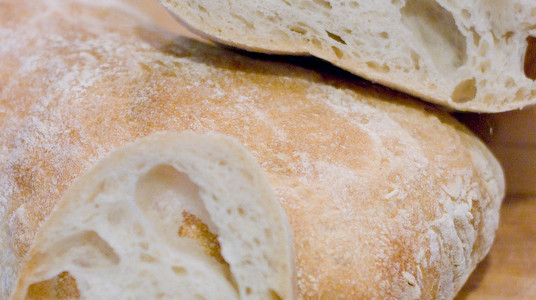
Well — here it is. Revision. Another year, another ciabatta.  This one is, you might note, not characterized by quite the gaping open crumb that you see in specimens from other quarters of the Internet.  That’s on purpose.  It’s because I subbed in a small proportion of whole wheat flour in an effort to improve the bread’s taste.  And it worked.  If you don’t like it — if you want a more traditionally open crumb — I can understand that.  Replace the wheat flour in the recipe with white, and bake away.  But I’d suggest trying it this way before you knock it.  It’s got a lot more flavor with the wheat.

Meanwhile, down to baking.  First, I wanted to offer you a couple of rules to help make rustic bread work in your kitchen.  And then, the recipe.

1) Unlike most of the breads I post here, don’t try this one without a stand mixer. Dough over about 75% hydration is a sticky mess, and you’ll want to take steps to maximize the proportion of dough that ends up getting cooked by minimizing the proportion that ends up all over you.

2) You’ll also need some dough scrapers. See above for the reason why.

3) This is not a bread for beginners. You don’t need to be a bread expert (gods know, I’m not!) to attain a good ciabatta. But some basic experience with baking technique really helps. If you’re just setting out on your journey into bread-baking, I’d suggest starting with something like my whole grain brown bread. Still rustic, but much more easily done.

4) You need a pizza stone for this. Sad but true. Hearth baking is essential to get anything like a real rustic bread. And it can’t be done without — you know — a hearth.

5) This recipe epitomizes the reason why I give bread ingredients in weight rather than volume. A cup of flour weighs anywhere between 100-200 grams. And when you’re dealing with high-hydration bread, that difference is vast. As in: the difference between having something that just barely holds together as a dough, and something that looks much more like flour soup.

500 grams Unbleached AP Flour
430 grams Water
50 grams Whole Wheat Flour
15 grams Extra Virgin Olive Oil
1.5 tsp Salt
.5 tsp Dried Yeast

The night before: In the work bowl of your stand mixer, combine the yeast, wheat flour, 100 grams of the white flour, and 300 grams of the water. Mix well and allow to stand, covered, overnight.

The day of: Add the remainder of the water to the work bowl, and with your stand mixer’s whisk attachment, mix on medium for about three minutes (this step is not absolutely required, but if the goal of making ciabatta is to get as much air into the dough as possible, it can’t hurt).

Add the remainder of the ingredients, switch out your whisk attachment for the dough hook, and mix on low until the dough comes together into a wet, shaggy mess. Then turn the mixer up to low-medium and knead for about 20 minutes (this dough will never stop being wet. But you will notice gluten forming).

At the end of that time, remove the dough to a well-oiled bowl, cover, and allow to rise for about three hours, giving it a stretch-and-fold once after 20 minutes, and again after an hour (instructions for stretching and folding may be found here).

When the dough is risen, set up your pizza stone for baking and preheat your oven to 500F. Remove the dough to a well-floured pastry board. Gently stretch the dough into an oblong oval, then fold it longways in thirds, as you might fold a letter. Place it seam-side up into a floured baker’s couche (or a folded flour-sack towel), cover, and allow it to proof for 45 minutes.

Then, when the dough has proofed, flip it over, out of the couche, onto a floured pizza paddle. Slide it into the oven, onto the pizza stone, and bake for 25 minutes, turning the bread halfway through.

Allow the bread to cool to room temperature before slicing.

(You can, of course, find many more fabulous bread recipes through Wild Yeast’s YeastSpotting Archive!)

Some Thoughts on Ciabatta

I’ve been playing a lot with rustic bread, and specifically with Ciabatta, recently. And I’ve had a couple of thoughts. They’re probably obvious if you know anything about artisan baking, but I’m kind of figuring it out as I go along. I don’t in any sense think that I’ve got it right yet. In fact, I’m dissatasfied with my recent attempts in almost every way. But I have figured a couple of things out. Maybe:

First, you need more water than you think you do. What ordinarily counts as a wet dough is a dry ciabatta, and won’t produce the level of openness that you expect in a good ciabatta crumb. A good baguette is about 65% hydration. I tried the ciabatta at 80% hydration, and it wasn’t enough. This most recent one is at about 83% hydration, which seems to be much more promising. Perhaps in the future 85%? 90%?

Second, you need to knead more than you think you do, and you need to do it with a stand mixer and a dough hook. At 83% hydration, dough looks a little bit like thick soup at first. And it takes a bit more than ten minutes at medium high on my mixer before it looks like bread dough. And even then, as soon as you stop the mixer, it goes back to being way too mushy to touch.

Which brings me to my next thought: even with all your kneading, you need to stretch and fold. After its turn in the mixer, I dump my dough on the counter, and give it a good stretch and fold, repeating two or three times. Then, after a half hour, I do it again. This helps develop the gluten, and helps your dough retain its shape.

Fourth, flour is your friend. At such high hydrations, a little bit of flour on the bread board to keep your dough from sticking isn’t going to make anything too dense. So be liberal with the flour, covering your work surface, and sprinkling on the dough itself before you cover it. You’ll be much happier in the end when your cling wrap comes away from the dough without taking giant chunks with it.

Fifth, as a corollary: a good dough scraper is your friend. Stainless steel and relatively sharp, preferably. It is much MUCH easier to fold wet dough when it isn’t sticking to your hands.

And finally: shaping? Who needs shaping? After the dough’s initial rise, degas it a little bit, sunder it atwain, and sort of stretch and fold it until it looks approximately like a ciabatta should. It takes some delicacy not to squish the dough such that it loses all of its beautiful big bubbles, but mostly, it’s just a matter of getting it off the board without it falling apart.

The results so far:

And a recipe:

450g Organic Unbleached All-Purpose White Flour
370g Water
2 tsp yeast
1.5 tsp salt

The Night Before:

Combine your yeast with 200g of water and 200g of flour. Mix well, cover, and leave on the counter overnight.

Baking Day:

To your sponge, add the rest of the flour, 100g of water, and your salt. Place in the stand mixer and knead for 5-7 minutes, until you have a bread dough.

Allow that dough to rest for 15 minutes. Then add the rest of your water, run the mixer slowly to blend the water in, then have it knead on medium for 10-12 minutes, until your dough goes from looking like soup to looking like bread.

While that is going on, spread some flour on a clean counter. Then, when the kneading is done, pour (yes pour!) your dough onto the floured surface. Fold a couple of times, sprinkle with flour, cover in plastic wrap, and leave for 30 minutes. After 30 minutes, fold a few more times, sprinkle with flour, and put the plastic wrap back in place.

Allow the dough to rise for about 2 hours on the counter. Then degas the dough just a bit, and using a dough scraper, cut it into two equally sized pieces. fold each piece in half, and elongate until it looks like a ciabatta, then cover and allow to proof for 50 minutes or so.

While the dough is proofing, place an empty pan at the bottom of your oven, and a pizza stone (or overturned cookie sheet) in the middle, and heat as high as your oven will go (usually 510F). In the last eight minutes of your dough’s proof, pour about 2 cups of boiling water into the pan on the bottom to create steam.

When your dough is done proofing, transfer it to a floured pizza peal or to the back of yet another cookie sheet, and slide both loaves onto your pizza stone. Pour another cup of boiling water into the pan at the bottom of your oven, close the door, and allow to cook for about five minutes. Then turn your oven down to 450, and allow to cook for another ten minutes. At the end of the ten minutes, turn the ciabattas around, and cook for yet another ten minutes. Then, when they are a golden brown, remove them from the oven, transferring them onto a rack to cool.

Wait at least two hours, until the bread is fully cooled, to cut into it.

Enjoy!